

GEM and Andromeda: What’s New in Meta Ads
Meta recently introduced two important systems for online advertising: Andromeda and GEM AI. These technologies change how ads are found, ranked, and shown across Facebook and Instagram.
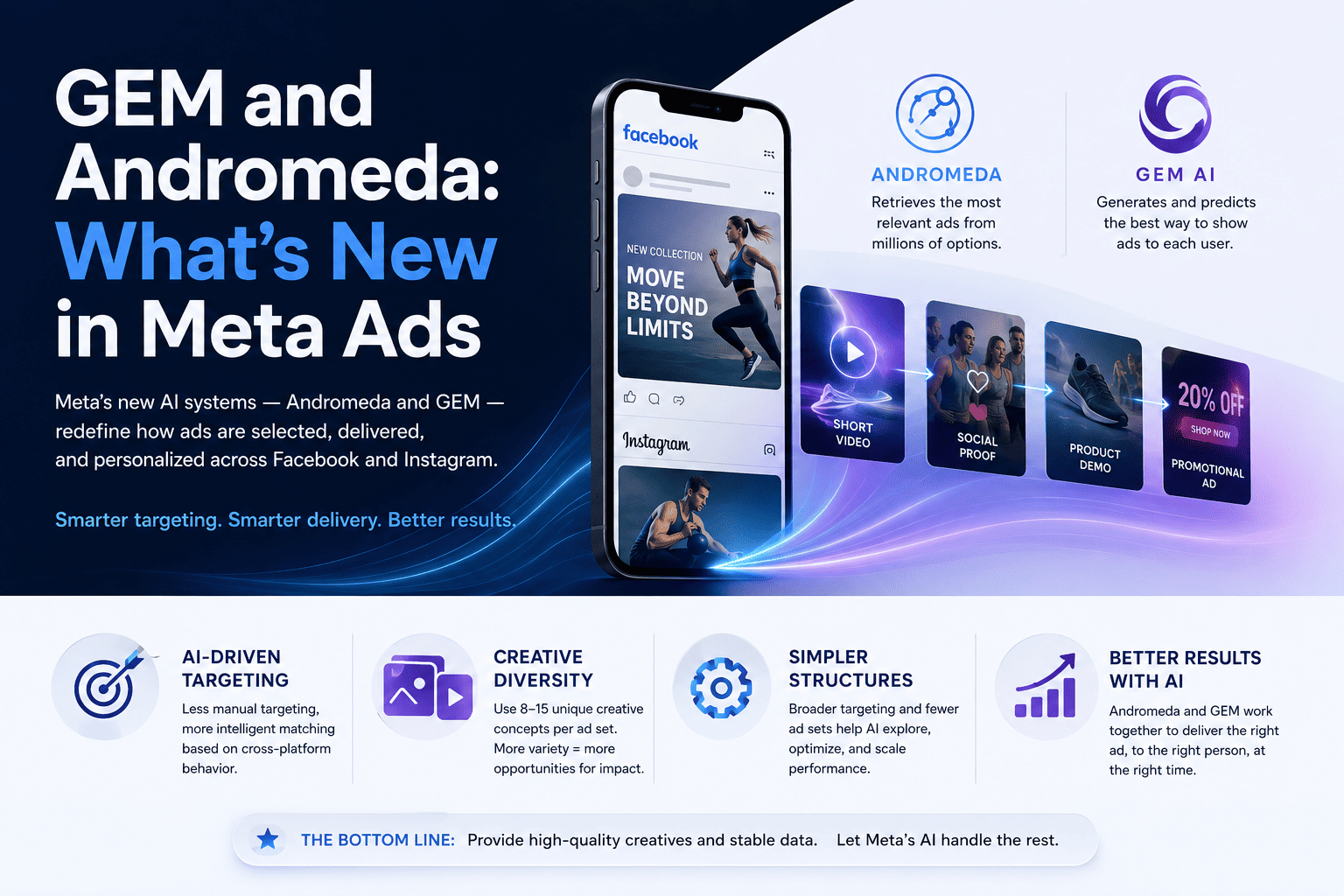
First came Andromeda – a machine learning system that picks relevant ads from a huge inventory. Then came GEM – a generative AI system that decides how those ads should be delivered and in what order.
Together, these systems move Meta advertising toward AI‑driven automation, reducing the need for manual tweaking.
Let’s break down the differences and share practical tips.
Andromeda and GEM: Two Different Roles
Some advertisers think GEM and Andromeda are part of the same update. But they actually do different jobs inside Meta’s ad system.
Andromeda: Which ads get a chance
Andromeda is a large‑scale machine learning system responsible for ads retrieval – the very first stage of ad delivery.
At this stage, Meta must choose from millions of possible ads and decide which ones even have a chance to be shown to a specific user.
Meta’s engineers designed Andromeda to improve retrieval using deep neural networks and specialized hardware. The system processes massive numbers of ads and narrows them down to a shortlist that can then be ranked and delivered.
Technical improvements include:
- Hierarchical indexing for large ad inventories
- Deep neural networks trained on user‑ad interactions
- Optimized pipelines for large‑scale delivery
Meta reports that Andromeda improved retrieval performance by +6% recall and +8% ad quality in certain segments.
In simple terms, Andromeda decides which ads are eligible to compete for a user’s attention. Another way engineers put it: the system narrows millions of ads down to a few thousand candidates before the ranking stage picks the final winner.
GEM: How ads are shown
If Andromeda decides which ads can be shown, GEM AI decides how they should be shown.
GEM is a generative AI system that analyzes patterns in user interactions, ad formats, and campaign performance. It predicts which combination of creative elements is most likely to get engagement or a conversion.
For example, instead of showing the same ad over and over, the algorithm might show a sequence like this:
- Short‑form video
- Social proof or user‑generated content
- Product demonstration
- Direct promotional ad
GEM feeds its predictions into Andromeda, helping decide what ad should appear next for each user. This makes the advertising system behave more like a recommendation engine than a traditional auction.
Cross‑Platform Behavioral Data
Another recent update connects behavioral signals more tightly across Facebook and Instagram.
Meta’s AI now builds a unified user profile based on activity across both platforms. This helps the algorithm decide the most effective place to deliver an ad.
Example:
A user watches a lot of fitness content in Instagram Reels. The system identifies related behavioral signals. Later, a relevant ad may appear in that user’s Facebook feed.
This cross‑platform modeling improves personalization and delivery.
How These Changes Affect Campaign Structure
The introduction of GEM and Andromeda changes how you should structure your ad campaigns.
Manual targeting becomes less important
In the past, advertisers relied heavily on detailed audience segmentation. Now, many decisions are handled by AI that matches ads to users automatically.
The core question has shifted from:
“Who should see this ad?” to “Which ad should this person see?”
Creative diversity is key
Because the system now selects ads dynamically, your creative library plays a much bigger role in campaign performance.
Experts recommend running 8–15 unique creative concepts per ad set. This gives the algorithm a chance to test different messages and formats. The algorithm tends to ignore near‑duplicate creatives – similarity detection treats them as the same concept.
Simpler campaign structures work better
AI‑driven systems perform better with broader targeting and fewer segmented ad sets. This allows the algorithm to explore more combinations of targeting and delivery.
Automation now handles:
- Bidding adjustments
- Budget distribution
- Audience discovery
- Placement selection
Tools like Advantage+ are designed to streamline campaign management and improve performance.
Summary
The rollout of Andromeda and GEM AI is a major shift in Meta advertising. The platform is evolving into a large‑scale AI recommendation system.
Instead of relying mainly on manual targeting and campaign setup, success now depends on:
- Algorithmic optimization
- Creative diversity
- Behavioral analytics
- Automated scaling
For advertisers, this means providing high‑quality creatives and stable campaign data that Meta’s AI can analyze and optimize.
FAQ
What is GEM in Meta Ads?
GEM is a generative AI system that analyzes behavioral signals and predicts which ad format or sequence to show a user. It works together with Andromeda.
What is Andromeda?
Andromeda is Meta’s machine learning ad retrieval engine. It scans large volumes of ads and selects the most relevant candidates before ranking and delivery.
How do GEM and Andromeda affect campaign performance?
Andromeda finds relevant ads for each user; GEM predicts which creative or message should come next. Together they improve personalization and engagement.
Should advertisers change their strategy?
Yes. Performance now depends less on manual targeting and more on creative diversity, AI‑driven optimization, and stable campaign data.
How to optimize campaigns after these changes?
Focus on broader targeting, diverse creatives, and consistent analytics signals. Let Meta’s AI optimize delivery and conversions.
The shift from “who should see this ad” to “which ad should this person see” changes everything. Creative variety is now more important than hyper‑targeting.
I appreciate how clearly this explains Andromeda vs GEM. One handles retrieval, the other handles sequencing. Together they turn Meta into a recommendation engine rather than just an auction.
Cross‑platform behavioral data (Instagram + Facebook) is the real game changer here. Unified user profiles mean better personalization without extra work from advertisers.