

Seeing Loss Differently: East vs West Through Eye-Tracking
Interactive games and decision-making tasks are built on probability. Big successes and disappointing failures are two sides of the same coin. The appeal of such challenges lies in uncertainty and the thrill of a possible reward. But what really happens in that moment? How does a person actually react to a win or a loss?
Eye-tracking gives us a surprisingly precise way to measure emotional and mental reactions. In psychology, eye behavior is widely used to understand what’s going on in the nervous system.
One of the clearest signals is pupil dilation. Pupils widen in response to emotions – whether it’s excitement, joy, fear, or frustration. They also dilate when we concentrate hard or process complex information. By analyzing pupil data together with other measurements, researchers can link these changes directly to the activation of the sympathetic nervous system (the “fight or flight” response).
Beyond pupils, eye-tracking also measures:
- Saccades – quick jumps between points of focus
- Fixations – pauses when the gaze rests and processes information
- Blink rate – which tends to drop when someone is highly engaged
Under stress, saccadic accuracy can drop. The eyes may briefly “miss” their target and need to correct. Longer fixations often signal that something emotionally intense is happening, making it hard to look away. Researchers also look at scanning patterns across the screen to see which elements grab attention and when.
Cultural differences: myth or reality?
At first glance, you might think these biological responses are universal – and at a basic level, they are. But perception is shaped by both biology and culture. Many of our behaviors are shaped by early cultural upbringing, including language and social norms. These factors influence how we distribute attention and process visual information.
In earlier research, we found noticeable differences between African, Asian, and European users. For example, players from Nigeria and Tunisia showed signs of contextual attention – they preferred having multiple objects within their visual field at once.
Our goal was to test the idea that a person’s cultural background influences both their reaction to outcomes and their long-term memory.
— Lev Polonuer, Pepper Partners CEO
In this latest study, we focused on European participants (from Austria, Hungary, and Poland) and Asian participants (from Singapore) to better understand the subtle differences between Western and Eastern cognitive patterns.
Participants played a simple three-reel matching game in a controlled lab setting. The game was designed to deliver a balanced mix of positive, neutral, and negative outcomes. We tracked their eye movements during play, analyzing how attention shifted with each result. After 48 hours, participants returned for memory tests to see what they remembered – including central and peripheral elements on the screen, as well as emotionally charged moments from their session.
East vs West: What changed after a negative outcome?
The clearest difference was in how attention was spread across the screen.
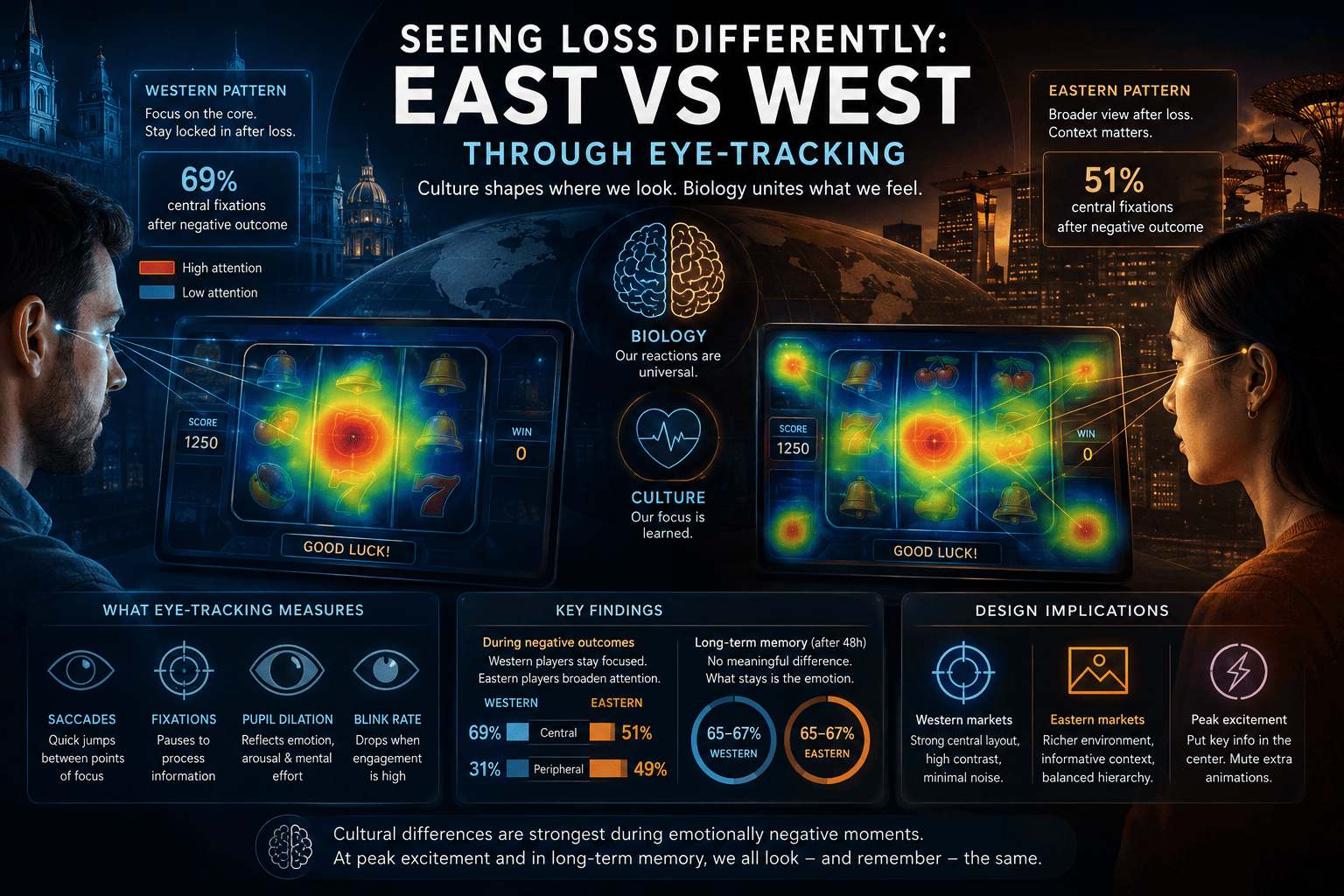
- European participants focused heavily on central elements. Overall, about 73% of their fixations were directed to the center. After positive outcomes, this rose to 76%, and even after negative outcomes it stayed high at 69%.
- Singaporean participants showed a more balanced pattern. Overall, about 57% of their fixations were central. After positive outcomes, they leaned toward the center (63%), but after negative outcomes, attention spread almost evenly – roughly 51% central and 49% peripheral.
While culture influenced initial attention and visual processing, it did not create meaningful differences in long-term memory.
— Lev Polonuer, Pepper Partners CEO
However, this difference did not carry over to memory. After two days, both groups performed almost identically on recognition tests. Accuracy was between 65% and 67% for both. So culture influenced initial attention and visual processing, but not long-term memory.
In other words, cultural differences became most visible during emotionally negative moments. Western players stayed locked on the core game elements. Eastern players broadened their view and engaged more with the surrounding background.
What this means for interface design
These differences in cognitive patterns suggest that interface design should be tailored to cultural preferences.
- Western users tend to be more analytic. Attention is focused on central objects, with background info treated as secondary or even distracting. For them, interfaces benefit from a strong central layout, high contrast, and minimal peripheral noise. Key elements (like game reels or score displays) should be visually dominant.
- Eastern users need a more holistic visual approach. They process objects in relation to their context, spreading attention more evenly across the screen. So a richer environment – with background animations and informative side panels – works well. Important information (like current score or reward totals) can be placed outside the center without losing meaning.
During calm moments, Western users focus on a presenter’s facial expression, while Eastern users pay more attention to background studio details.
Interestingly, at peak excitement, biology overrides culture. During calmer periods, the patterns above hold. But during highly intense moments (like special high-reward rounds), both groups showed “tunnel vision” – attention narrowed sharply toward the center. That means in intense moments, all critical information should be placed in the center of the screen for clarity.
Similarly, when it comes to retention, cultural differences fade. Two days later, participants did not remember specific visual details. What stuck with them was the emotional experience of success or failure. So follow-up campaigns and messages should appeal to that emotional high, rather than referencing interface details.
Practical takeaways
- For Western markets: prioritize central elements, reduce peripheral visual noise, use strong contrast to guide attention quickly.
- For Eastern markets: build a cohesive, visually rich scene while keeping a clear visual hierarchy so important elements don’t get lost.
- During peak excitement: put all essential information in the center and temporarily mute unnecessary animations and pop-ups.
- Localization should go beyond text. Visual layout and animation pacing should be tested regionally – using A/B testing, heatmaps, and eye-tracking where possible.
Fascinating how culture shapes even our eye movements. The finding that Westerners lock onto the center during losses while Easterners scan the periphery is a great reminder that UX design isn’t one-size-fits-all.
What really stood out to me is that long‑term memory depends on emotion, not visual details. So follow‑up campaigns should focus on how users felt, not what they saw. That’s a powerful insight.