

Is Your Email Program Breaking the Golden Rule of Content Marketing?
Let’s be real: while everyone’s obsessing over social media algorithms and AI tools, email is quietly doing its job in the background. It delivers steady open rates, reliable click-throughs, and marketers just keep hitting “send.” But here’s the problem — audiences are drowning. Intuit Mailchimp’s Art of the Opt-In report surveyed 6,000 consumers and found that most are getting more brand emails than ever, yet a quarter of them admit they’re tuning out more than before. Meanwhile, only 23% of marketers think their email lists are truly high quality.
So what’s going wrong? Many email programs are violating content marketing’s number one rule: Always think about the audience first. We’re asking for information we don’t need, interrupting people at the wrong time, and ignoring how often they actually want to hear from us. Here’s how to fix that.
Stop asking for so much. Seriously.
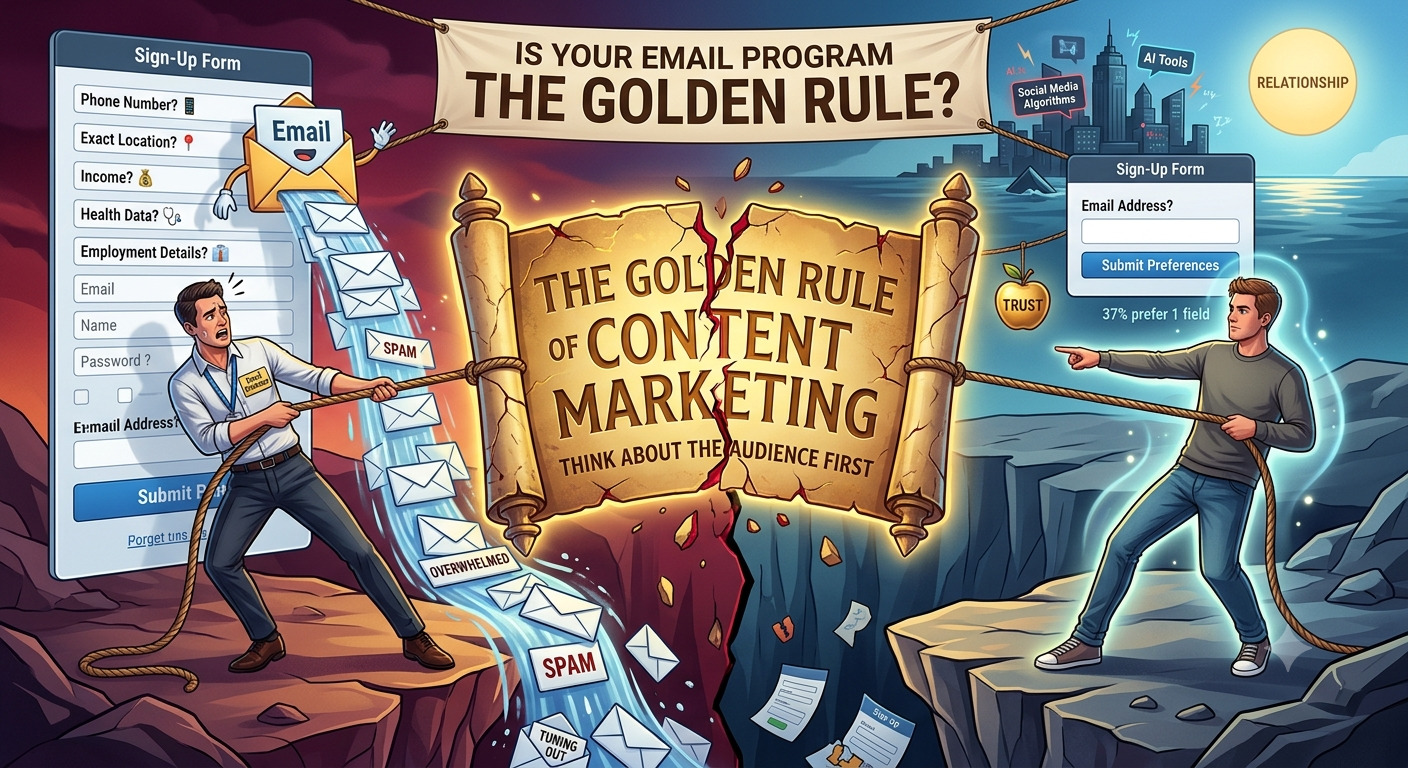
Forty percent of marketers say friction in the sign-up process is a major hurdle, and it’s easy to see why when you look at the tug-of-war happening. Marketers often build forms based on what they want to know, not what subscribers are willing to share.
Take phone numbers: 65% of marketers ask for one, but only 28% of consumers are willing to give it. (And honestly, how many of those numbers are even real? I’ve used my old landline for years to dodge sales calls.) What about location? 37% of marketers ask for it, but only 17% of consumers feel comfortable sharing. Unless you’re mailing physical catalogs or need to comply with specific laws, you probably don’t even use that data — and you can usually infer location from IP addresses or past purchases anyway.
So what do people actually prefer? A minimalist form:
- 37% want just one field (the email address, obviously).
- 34% are okay with two fields.
- Only 16% will tolerate three, and a tiny 6% accept four or more.
If you absolutely must add a second field, skip the first name — that level of personalization is basic enough to assume. Instead, ask what kind of content they want to receive or how often they want to hear from you. That shows you respect their preferences, not just their wallet.
Timing is everything — and it’s not about seconds on a page.
We’ve all experienced it: you land on a website and instantly a pop-up begs for your email. You think, “I just got here. Why would I give you anything?” Unsurprisingly, only 18% of consumers opt in the moment they arrive. So how do the best-performing marketers get conversion rates above 20%? They time their pop-ups based on visitor intent, not just an arbitrary 10-second timer.
Half of consumers say they’re most likely to opt in after browsing, and a third say right before making a purchase. So read the signals. Someone lingering on a product page is showing purchase intent — that’s the perfect moment to offer a discount code in exchange for an email. A visitor deeply reading a blog post has informational intent — that’s when a newsletter subscription prompt makes sense. Use your own first-party data: which pages lead to opt-ins? Which prompts consistently flop? And don’t ignore your unsubscribe data; it can reveal where you’re going wrong.
Earn trust with more than just words.
Trust is the bedrock of any email relationship. 94% of marketers say it’s important for signups, and consumers agree. When unfamiliar brands ask for an email address, people are more likely to say yes if they see:
- Customer reviews and testimonials (45%)
- Secure site signals like HTTPS and trust badges (43%)
- A clear, easy-to-find privacy policy (40%)
- A clean, professional-looking form (35%)
Trust also grows when you don’t ask for overly personal stuff. Over half of consumers would never share family information (55%) or health data (55%). Nearly half refuse employment details, and around a third won’t give location or phone numbers. If you really need that info, at least mark those fields as optional.
And then there’s frequency — a huge trust factor. 91% of consumers say having control over how often and what type of messages they receive is important. 74% don’t want more than two emails a week from a brand. Yet 21% of marketers blast subscribers several times a week in the first month alone. Handing over frequency control, or simply respecting stated preferences, immediately sets you apart.
Make an offer they actually want.
Trust gets you in the door, but the right incentive seals the deal. Top-converting marketers lean heavily on discounts, giveaways, and value-added bonuses. If your sales team can’t offer discounts, try early access — the research shows it’s one of the most effective incentives among high performers. The key is to use what your own subscriber data tells you works, not just follow generic advice.
Remember the rule.
Email marketing isn’t magically exempt from content marketing’s core principle: think about your audience. Look at your opt-in forms, pop-up timing, and incentives. Were they built for what your business wants, or for what your subscribers actually prefer? When you close that gap, you’ll build a healthier list that works better for everyone — and finally stop violating that golden rule.
I love the shift from ‘time on page’ to ‘visitor intent.’ It’s such a simple reframe: someone reading a blog post and someone staring at a product page are in two completely different mindsets. Treating them the same with a generic pop-up suddenly feels lazy.
The stat about phone numbers really hit me — 65% of marketers ask for it, but only 28% of people are willing to share. I’m definitely guilty of putting that field on forms just because ‘everyone else does,’ without ever actually using the numbers. Time to clean house.
Over 90% of consumers say frequency control is important, yet we still bludgeon new subscribers with daily emails. That disconnect is a trust killer. Giving people a simple preference center up front feels like the easiest win in the entire article.