

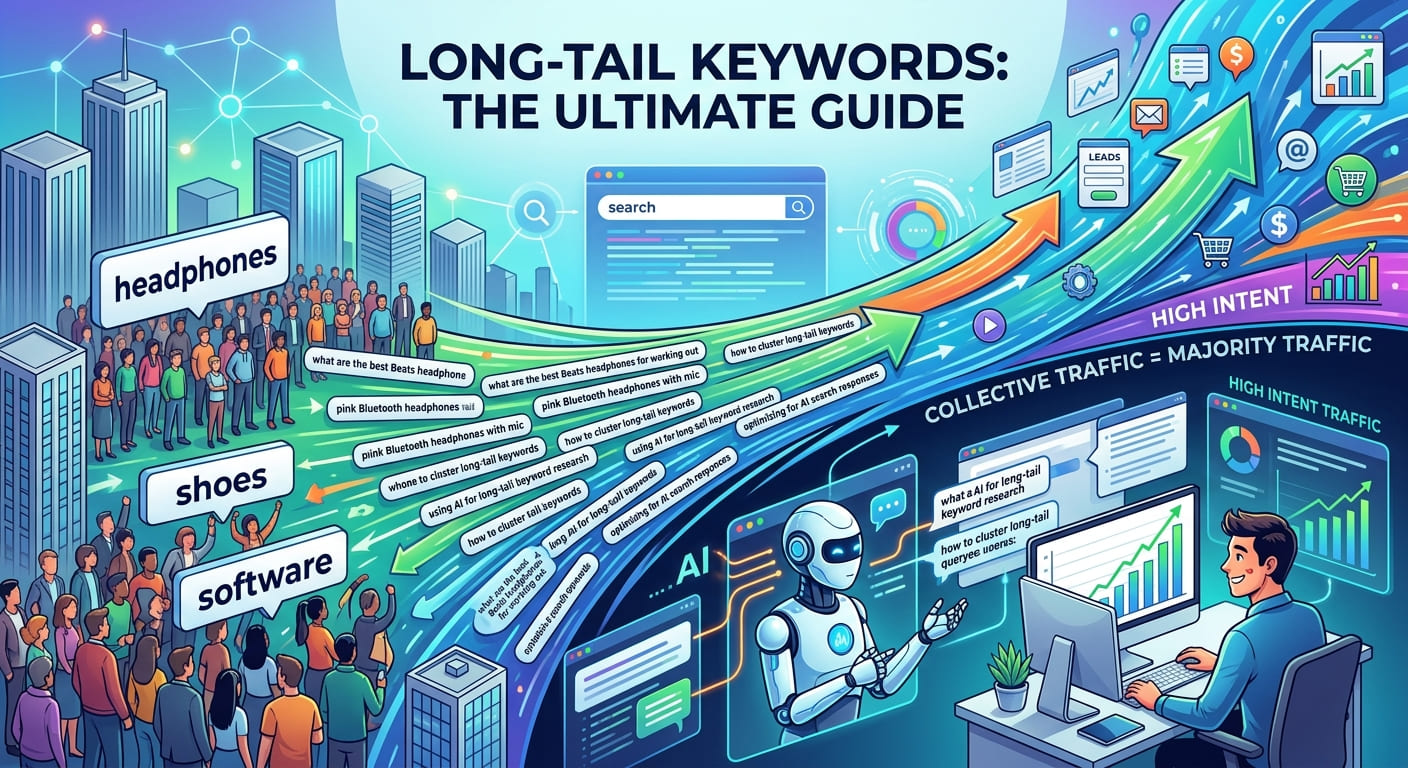
Long-Tail Keywords: The Ultimate Guide
What’s the Big Deal About Long-Tail Keywords?
Most people overlook long-tail keywords. Why? Because each one individually brings in just a handful of searches per month. When you’re scanning a keyword list sorted by popularity, they never catch your eye.
But here’s the catch: when you group them together, they often make up the majority of your site’s search traffic.
And with AI search now in the picture—think AI Overviews, Google AI Mode, and chat-based assistants—long-tail keywords have become even more critical. These AI systems love answering specific, question-shaped queries directly. If you want to show up in those responses, long-tail phrasing is your ticket in.
Let’s dive into what long-tail keywords actually are, why they matter more than ever, how to find them, how to rank for them, and how to track your progress.
What Are Long-Tail Keywords?
Simply put, long-tail keywords are super specific search queries. People use them when they’re looking for something very particular or when they’re searching conversationally.
Think of them as the difference between:
- Short-tail: “headphones” (super broad, huge competition)
- Long-tail: “what are the best Beats headphones for working out” (very specific, low competition)
These queries don’t get thousands of searches a month. But the people using them usually know exactly what they want.
The Spectrum: Long-Tail vs. Mid-Tail vs. Short-Tail
| Type | Specificity | Search Volume | Competition |
|---|---|---|---|
| Short-tail | Very broad | High | High |
| Mid-tail | Somewhere in between | Medium | Medium |
| Long-tail | Very specific | Low | Low |
The line between mid-tail and long-tail isn’t always clear-cut. Use your judgment based on your niche and what feels specific enough.
Why Long-Tail Keywords Matter in SEO
Here’s why you should care about long-tail keywords:
1. They’re Easier to Rank For
Because they’re so specific, fewer websites are competing for them. That means less competition and a better shot at landing on that coveted first page of Google.
You can check how hard a keyword is to rank for using metrics like:
- Keyword Difficulty (KD%): General difficulty to rank in Google’s top 10
- Personal Keyword Difficulty (PKD%): Difficulty specifically for your website
2. They Bring High-Quality Traffic
People who use long-tail keywords often have high buying intent. They know exactly what they want and are close to making a decision.
Someone searching for “pink Bluetooth headphones with mic” is way more likely to buy than someone searching for just “headphones.” They’re not just browsing—they’re ready to act.
3. Grouped Together, They Pack a Punch
Sure, individual long-tail keywords might have monthly search volumes as low as 30. But when you group them together around the same topic, you can capture significant traffic.
For example, a cluster of related long-tail keywords might collectively bring in 980 searches a month—far more than focusing on just one.
Instead of creating separate pages for each variation, group related queries onto a single, comprehensive page. This way, you capture the whole cluster’s volume without diluting your site with near-duplicate content.
4. They Help You Appear in AI Responses
AI search is conversational. People type full questions into ChatGPT, Google AI Mode, and other assistants. Long-tail keywords match that natural language perfectly.
Here’s what makes them work in AI search:
- AI tools use query fan-out: They expand a single question into many related sub-queries. Targeting a range of long-tail variations means your content can match more of those sub-queries.
- AI systems pull specific passages: They don’t grab entire pages—they extract specific answers. A page built around clear questions (one heading, one self-contained answer) gives AI systems exactly what they need.
How to Find Long-Tail Keywords
Ready to start hunting? Here are the best methods:
1. Use Keyword Research Tools
Tools like Semrush’s Keyword Magic Tool are goldmines. Here’s the basic approach:
- Enter a broad seed term (e.g., “headphones”)
- Add your domain and target country
- Filter results by:
- Search volume: 0-1,000
- Keyword difficulty: 0-29%
- Word count: 3+ words
You can also apply the “Questions” filter—question-based keywords are almost always long-tail by nature.
2. Explore Google Autocomplete
Just start typing relevant terms into Google’s search bar and watch the suggestions roll in. These predictions come from real searches, so they’re a great source of ideas.
Just keep in mind:
- Results are personalized to you
- You won’t get search volume or difficulty data (you can check those in a tool like Keyword Overview)
3. Check “People Also Ask” Boxes
Google’s PAA boxes are full of questions—and many of them are perfect long-tail keywords.
You can find them by:
- Running relevant Google searches
- Using tools like AnswerThePublic to collect them in bulk
Again, you’ll need a separate tool to check volume and difficulty.
4. Look at Your Current Rankings
Check what you’re already ranking for in Google Search Console. Look for queries where you’re in positions 11-20—that sweet spot where you’re close to the top 10 and could climb with a bit of effort.
Semrush’s Organic Rankings tool lets you filter by volume and difficulty, making it even easier to spot promising long-tail keywords.
5. Spy on Your Competitors
See what keywords your competitors rank for—and which ones might be easier for you to target. Enter their domain into Semrush’s Organic Rankings, filter for low-volume, low-difficulty keywords, and save the best ones.
6. Ask AI Chatbots
ChatGPT can generate tons of long-tail keyword ideas. Try a prompt like:
“Generate 50 long-tail, question-style search queries related to [your topic], grouped by whether the searcher is comparing options, troubleshooting a problem, or looking for a how-to.”
This gives you a structured list to filter through. But remember: AI doesn’t have real search data, so cross-check results in actual keyword tools.
7. Explore Online Communities
Reddit and Quora are packed with real questions from real people. These platforms show you the exact language your audience uses, which you can then mirror in your content.
8. Use Conversational and Zero-Volume Keywords
Some of the best long-tail keywords show zero volume in research tools. That doesn’t mean nobody’s searching for them—it means the variations are so fragmented that no single version registers measurable data.
Voice searches and AI chats produce long, natural-language questions. A query like “what are family-friendly things to do near a downtown convention center on a weekday afternoon” might get typed a dozen slightly different ways, each showing zero volume individually.
Check your site’s internal search logs or support chat transcripts—they’re goldmines for these ultra-specific, real-world queries.
9. Do Prompt Research
Semrush’s Prompt Research tool shows you the actual prompts people use in AI platforms like ChatGPT and Google AI Mode. Look for prompts with high relevance, see which brands get mentioned, and figure out how you can create more helpful content to earn those mentions.
How to Rank for Long-Tail Keywords
Ranking for long-tail keywords isn’t rocket science, but it does require strategy. Here’s what works:
Create Keyword Clusters
Group your keywords by search intent. Target multiple related keywords on a single page rather than spreading them thin across separate pages. Prioritize clusters that seem most valuable (e.g., those likely to drive sales or conversions).
Pick the Right Format
Decide whether a keyword cluster deserves its own dedicated page or fits better as a subsection within a broader article. Base this decision on search intent and your overall content strategy.
Focus on Helpfulness
Write content that genuinely addresses your audience’s needs. Search engines and AI systems love sites that demonstrate real expertise on a topic. Only target keywords that align with your authority.
Use Keywords Naturally
Incorporate keywords into:
- Title tags
- Headings
- Alt tags
- Body content
But always prioritize natural, readable content over keyword stuffing. Your audience (and Google) will thank you.
Optimize Filter Pages (For Ecommerce)
If your site has filtering options (like price or color), make sure your most important filter pages are:
- Accessible to search engines
- Have unique, crawlable URLs
- Include unique content (not just product grids)
Use Schema Markup
Help search engines understand your content better. FAQ schema, for example, can help identify questions and answers on your page.
Build Internal Links
Link to your long-tail pages from related pages on your site. This helps both users and search engines discover and understand your content.
Structure for AI Retrieval
Here’s a pro tip: write each section so it can stand alone. Use:
- A clear heading
- A direct opening sentence that answers the question
- Enough context that the section makes sense without the rest of the page
This helps AI systems pull your content into their answers—and makes your pages easier for human readers to skim.
Long-Tail Keywords for PPC
Finding long-tail keywords for pay-per-click campaigns is similar, but with a focus on:
- Competitive Density: Look for scores between 0 and 0.2 (lower is less competitive)
- Cost Per Click (CPC): Filter between $0 and $0.50 to start
These metrics help you find keywords that are cheaper to bid on, giving you a better ROI.
Real-World Examples
SaaS Example: Wave
Wave, an accounting software company, built a page targeting “free accounting software for nonprofits.” Content was tailored specifically for that audience, with keywords woven in naturally. Result? The page ranked in the top 3 for 28 keywords (mostly long-tail), drove 783 monthly visits, and generated $5.2K in traffic value. Plus, they appeared prominently in ChatGPT responses for related queries.
Local Example: Choose Chicago
Choose Chicago created an FAQ page answering multiple questions about a single attraction. By grouping related questions together, they targeted a range of short-, mid-, and long-tail keywords. That single guide ranked in the top 3 for 516 keywords.
Ecommerce Example: Wayfair
Wayfair’s product filter pages are optimized for long-tail searches. Each filter combination gets its own URL, title tag, and meta description. This approach helps them rank for specific queries like “blue velvet living room set” and earn AI mentions for related prompts.
How to Track Your Long-Tail Keyword Rankings
Keep tabs on your progress with:
Google Search Console
Shows metrics for up to 1,000 queries:
- Clicks
- Impressions
- Click-through rate (CTR)
- Position
Semrush Position Tracking
More detailed tracking for keywords of your choice:
- Actual vs. potential position
- Competitor rankings
- SERP features (like People Also Ask)
- Estimated traffic vs. potential traffic
- Visibility in ChatGPT and Google AI Mode alongside organic rankings
Final Thoughts
Long-tail keywords may not seem impressive on their own, but together they’re a powerhouse. They’re easier to rank for, bring high-intent traffic, help you show up in AI responses, and can generate significant collective search volume.
The key is to find the right ones, create helpful content that addresses real needs, and track your results over time. Start small, focus on quality, and watch your traffic grow.
The section on zero-volume keywords is a real eye-opener. So many people skip these because tools show no data, but the author makes a compelling case for why they’re worth pursuing—especially with voice and AI search on the rise.
Love the practical examples from Wave, Choose Chicago, and Wayfair. It’s one thing to talk about theory, but seeing real companies apply these strategies makes it all click. The Wayfair filter page example is particularly clever.
The advice on structuring content for AI retrieval is gold. Writing standalone sections with clear headings and direct answers isn’t just good for AI—it’s better for human readers too. A win-win