

The 5 Skills You Actually Need to Become an AI-Native Marketer
Let’s get straight to it: marketers who just use AI tools to help with individual tasks are becoming replaceable. The ones who are building entire workflows and systems around AI? They’re pulling ahead — harder to compete with, more in demand, and delivering work that solo tool users simply can’t match.
That’s not a wild guess. Over the past few months, CXL surveyed hundreds of B2B marketers and analyzed how AI is reshaping roles and expectations. The clearest signal from that research is that “AI-native” isn’t a buzzword — it’s where the industry is headed, and what companies are increasingly hiring for. But most marketers don’t really know what AI-native means, and even fewer know where they personally stand on that journey.
Here’s what the progression actually looks like, the five skill areas where the gap is widest, and what meaningful progress looks like in each.
The three levels of AI maturity
Before we dive into skills, it helps to understand the three stages most marketers move through:
- AI-Assisted: You use AI tools in isolation — ChatGPT for a draft, Perplexity for research — but the steps between tools are all manual copy-paste.
- AI-Integrated: You start connecting tools and automations to streamline parts of your workflow, reducing manual handoffs.
- AI-Native: You redesign operations from the ground up so AI is the default engine. You build systems and agents that run without constant human nudging.
Most B2B marketers are somewhere between assisted and integrated. The leap to AI-native is where the biggest career and performance opportunities now live.
The 5 skill gaps (and what to do about them)
Our research uncovered five domains where the skill gap is largest — and where catching up can separate you from the pack.
1. Production & Content
The data: 46% of B2B marketing leaders want the entire content engine off their plate. Yet 42% say generic-sounding AI output is their top failure. Everyone wants scalable AI content, but almost nobody has solved the quality problem that makes scale trustworthy.
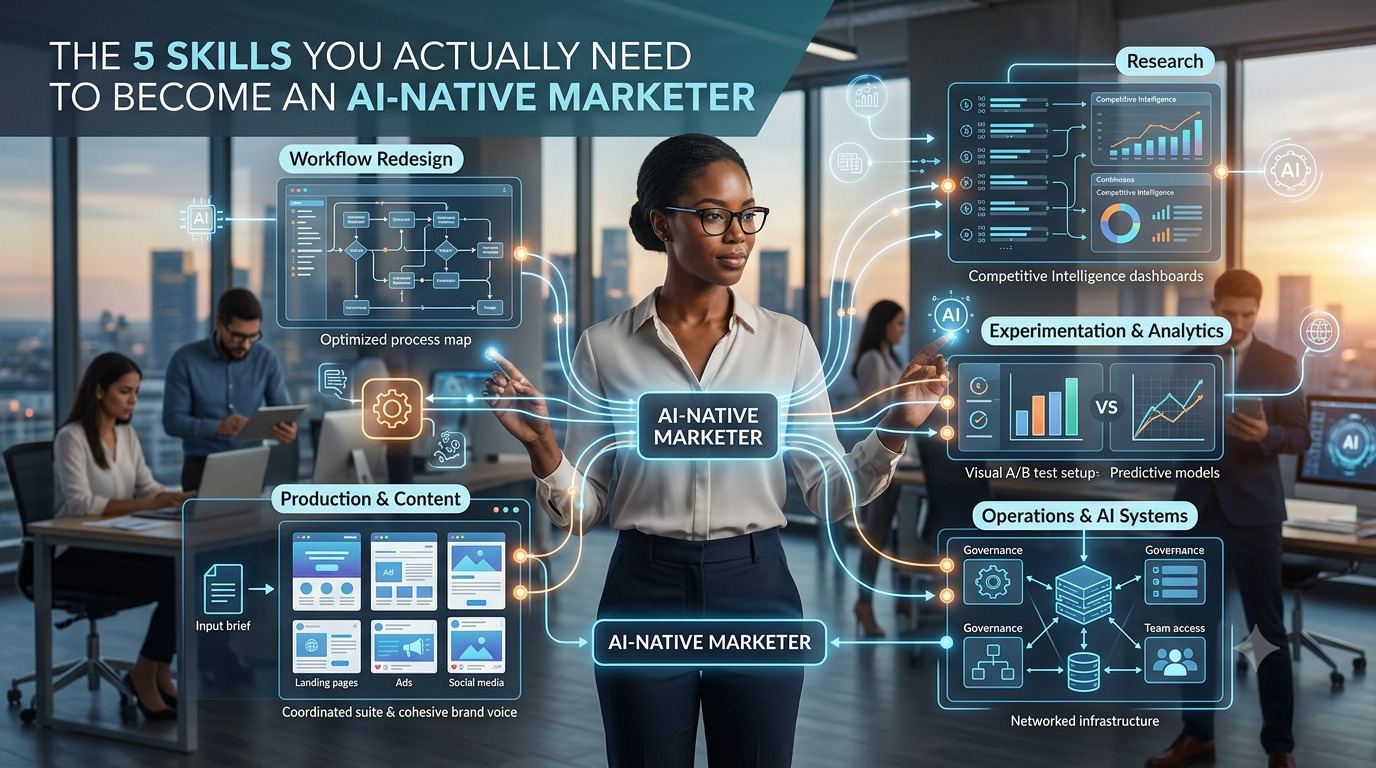
What AI-native marketers do differently: They stop producing content one piece at a time. They build systems where a single brief becomes a coordinated set of assets — ads, landing pages, emails, social variants — all in a consistent brand voice, optimized for both humans and AI search results. The input is one brief; the output is multiple platform-ready pieces.
The gap: Most marketers are still manually adapting content per channel. AI-native marketers build a production line.
2. Research
The data: 42% already use AI for research, but most still hop between tabs, manually copying and pasting.
What AI-native marketers do differently: They set up research pipelines. Instead of running ad-hoc queries, they create workflows that automatically surface competitive intelligence, audience shifts, and trend signals — cross-checked against multiple sources — and deliver it in a ready-to-use format every Monday morning.
The gap: Using AI for research saves a bit of time. Building a research system saves hours every week and gives you insights your competitors are missing.
3. Workflow Redesign
The data: 55% of marketers rate themselves as beginners here. Only 10% recognize it as one of the most important skills to develop. This is the overlooked meta-skill.
What AI-native marketers do differently: They stop asking “How do I use AI more?” and start asking “Which workflows should I retire, which should I rebuild, and which should I design from scratch?” This means mapping out current processes, spotting where human input is genuinely necessary versus just habitual, and restructuring operations so AI handles the high-volume, low-judgment steps while humans focus on strategy, taste, and final approval.
The gap: Most skill-building focuses on prompting and tool tips. Workflow redesign is what turns all those other skills into actual leverage.
4. Experimentation & Analytics
The data: 42% say they are beginners at running experiments and analyzing performance. 37% say hallucinated data is their number-one AI failure.
What AI-native marketers do differently: They build analytics workflows that automatically pull performance data from multiple platforms, spot anomalies, generate hypotheses about what’s causing them, and suggest experiments — complete with expected impact and confidence intervals — without needing a data analyst to run the process.
The gap: Most marketers still interpret data manually or wait on data teams. AI-native marketers have lightweight intelligence running continuously, flagging what matters.
5. Operations & AI Systems
The data: 42% say building AI systems is their most-wanted skill. A full 65% still rate themselves as beginners. This is the highest-impact skill, and the gap between desire and ability is enormous.
What AI-native marketers do differently: They recognize that personal AI use hits a ceiling. One marketer with ChatGPT can do more, but they’re still limited by their own time. The real unlock is building systems the whole team can use — with approval flows, quality checks, governance, and documentation that let AI-native operations scale.
The gap: Most marketers are building personal AI productivity. AI-native marketers are building team-level AI infrastructure.
Not sure where you stand?
Most people know these five areas are important. The harder part is honestly assessing your current level across all of them and deciding what to tackle next. The marketers who build a durable edge over the coming years won’t simply be using AI tools — they’ll be the ones who build the systems, redesign the workflows, and structure operations so AI is the default, not an optional add-on.
The operations gap — 42% want system-building skills but 65% are beginners — is a massive career signal. Being the person on the team who can build scalable AI infrastructure, not just use the tools, feels like the safest job security move right now.
The distinction between AI-assisted and AI-native is the most useful framework I’ve seen in a long time. I’ve been patting myself on the back for using ChatGPT daily, but I’m definitely still stuck in assisted mode — everything I build requires manual handoffs.