

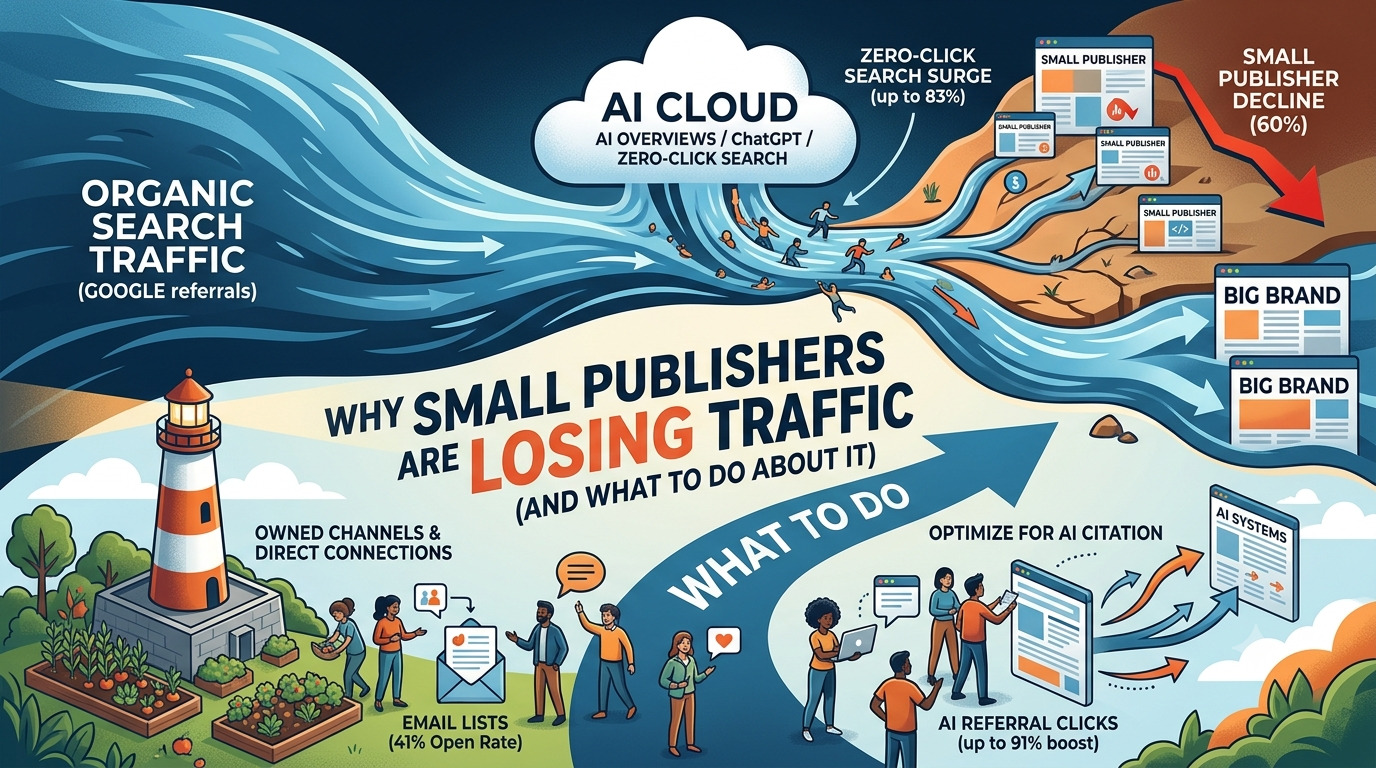
Why Small Publishers Are Losing Traffic (And What to Do About It)
If you run a smaller website or content-driven business, you’ve probably felt it: the steady drip of disappearing visitors from Google. This isn’t a temporary algorithm hiccup. It’s a fundamental shift in how people find information online — and small publishers are getting hit the hardest.
According to Chartbeat data tracking thousands of news sites worldwide, Google search referrals dropped 33% in 2025 alone. For tiny publishers with fewer than 10,000 daily page views, the picture is far grimmer: traffic has fallen as much as 60% over two years. Not a blip. A trend.
The culprit? AI-generated answers. When someone asks a question now, platforms like Google’s AI Overviews, ChatGPT, or Perplexity often serve up a neat summary stitched together from multiple sources. The user gets their answer without ever clicking a link. The publisher who researched, wrote, and optimized that content gets nothing.
The disappearance of the click
Zero-click searches — where a query ends without anyone visiting a site — have surged from 56% to 69% in just one year. When an AI Overview appears, the zero-click rate jumps to a staggering 80-83%. In those moments, users click on actual results only 8% of the time, down from 15% without the AI summary. That’s nearly half the clicks gone in an instant.
And yes, big brands weather the storm better. Large publishers saw a 22% referral decline, medium ones 47%, and small ones that brutal 60%. But even household names aren’t immune: Business Insider’s organic search traffic fell 55% between 2022 and 2025; HuffPost lost half. Ranking number one no longer guarantees a visitor. Visibility without a click is hollow.
The old playbook is dying
For a decade, the formula was simple: rank high in search, get traffic, make money. That engine is sputtering. Media leaders across 51 countries now expect traditional search effort to shrink, and they fear a further 43% drop in search referrals over the next three years. What separates the publishers who are holding steady? They’ve already built direct relationships with their audiences — email lists people actually open, social media communities that engage, and loyal readers who come back on their own. Publishers still clinging only to keyword strategies and hoping search traffic returns are falling further behind.
What to do right now
You need a two-pronged approach: protect your direct connections and make sure AI can find and cite your content.
First, make your owned channels your new front door. Email is your most resilient asset. In 2025, publishers sent 28 billion emails, reaching 255 million readers, with open rates above 41%. That’s dramatically better than most social media reach. Build your list relentlessly. Give people a reason to subscribe and show up.
Social media helps, too. Chartbeat data shows social referrals were flat or slightly up last year — X rose 15%, Facebook 9%. Not explosive, but they’re holding while search slides. Consistent presence across platforms your audience actually uses keeps you visible without relying on Google. Earned media — being covered by trusted outlets — also boosts your authority and raises the odds of being cited by AI systems.
Second, optimize for AI citation, not just search ranking. There’s a silver lining: brands that get cited in AI Overviews earn 35% more organic clicks and a remarkable 91% more paid clicks than uncited competitors for the same queries. Being the source an AI trusts is becoming the new page-one ranking.
Make your content clear, well-structured, and directly answer the questions people ask. Practical resources like how-to guides and explainers are cited more often in AI referrals. Use Google Search Console’s dedicated AI search tracking (added in mid-2025) to see where you already appear in AI Overviews and where you don’t. Check what major AI platforms say about topics you should own. If you’re being overlooked or replaced by less accurate sources, that’s a content gap demanding immediate attention.
Looking ahead
AI platforms generated over a billion referral visits in mid-2025 — a 357% year-over-year leap — but that’s still less than 1% of total web traffic because the search traffic swallowed by AI is so enormous. The 60% decline didn’t happen in a day, and it won’t reverse on its own.
The publishers who act now — nurturing direct subscriber relationships and becoming a trusted source for AI answers — will be in a vastly stronger position two to three years from now. Those waiting for the old search traffic to magically return are betting against the tide.
Seeing email open rates above 41% while social media stagnates makes me think I’ve been undervaluing my newsletter. It’s a distribution channel I actually own, and no algorithm change can take it away. That’s where I’m investing next.
The statistic that brands cited in AI Overviews get 91% more paid clicks really reframes the whole “AI is stealing our traffic” panic. It suggests that if you can become the source, you’re not just surviving — you’re gaining an advantage.