

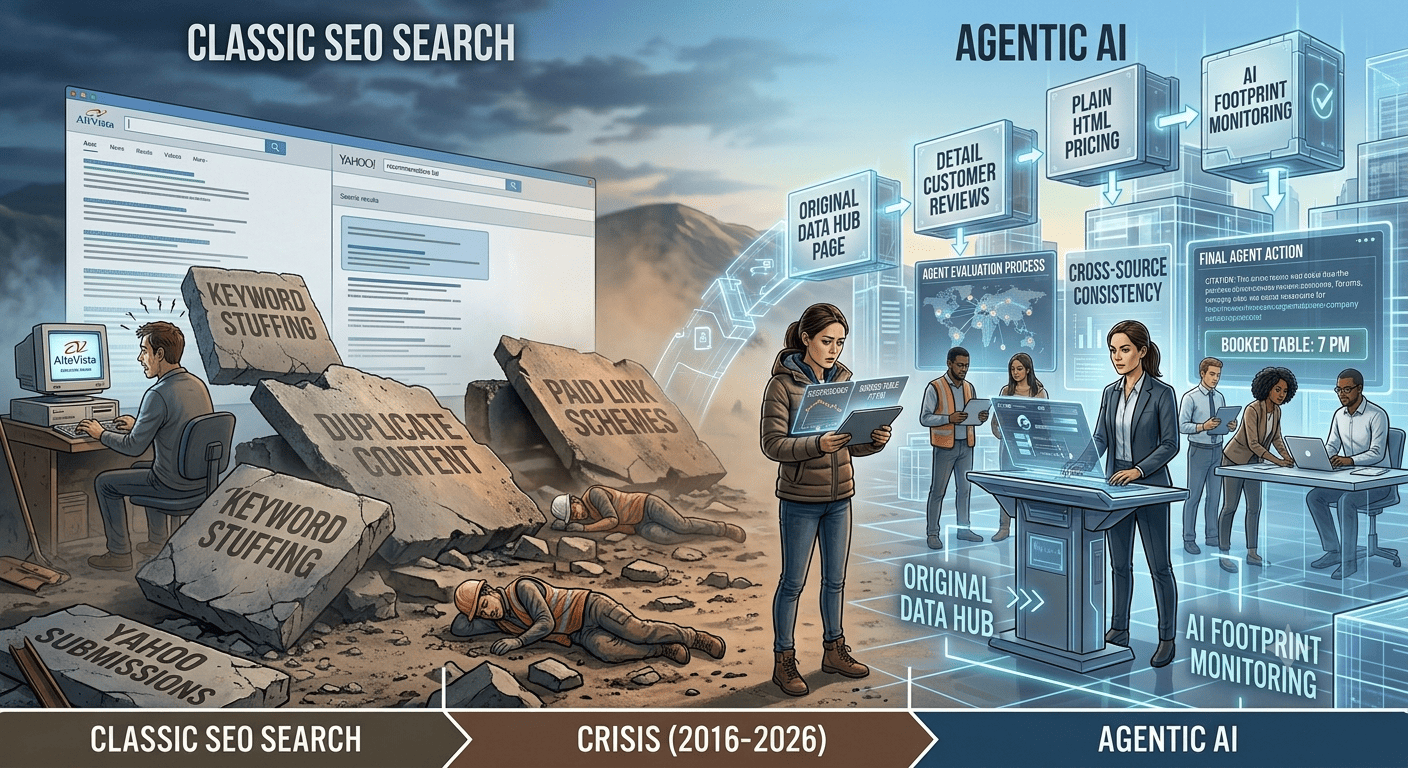
What Is Agentic Search? And why it matters for your brand right now
AI search exists on a spectrum. On one end, you ask a question and get a quick answer. On the other end, an AI gets a goal and goes out to browse the web on your behalf – evaluating brands, making decisions, and leaving no trace in your analytics.
That’s agentic search. And it’s already happening.
ChatGPT’s deep research, Gemini’s agentic mode, and Perplexity’s research features are early versions of it. Shopping inside ChatGPT and booking tables without ever visiting a website are already here – and expanding fast.
The brands that show up in these AI evaluations aren’t waiting to see how this develops. They’re optimizing for it now.
What agentic search actually is
Agentic search is AI that searches and acts on your behalf – not just composing an answer from its training data, but going out to find information, use tools, and complete tasks.
At the simpler end, the AI finds sources and summarizes a response. At the more complex end, it breaks a goal into sub-tasks, searches across multiple sources, cross-references what it finds, and takes action – without waiting for you at each step.
Examples in action
Simple example: you ask “Which project management software is best for a remote team of ten?” The AI doesn’t just answer from memory. It goes online, searches comparison articles, pulls pricing and features from review platforms, and synthesizes a recommendation.
More complex: you ask the AI to research your competitive landscape. It formulates a plan, runs multiple searches across news, reviews, company pages, and industry analysis. You get a structured report.
Even further: some agents don’t need a prompt at all. Configured with a recurring task – like monitoring competitor pricing or summarizing industry news weekly – they run on a schedule.
At the furthest end: the AI finds the right option, evaluates it against alternatives, and completes a transaction on your behalf. You asked for a recommendation. It booked the table.
Google confirmed at I/O 2026 that this type of agentic booking is expanding significantly – covering local experiences, home repair, beauty, and pet care in the US starting summer 2026.
Why this is different from what SEOs already know
Agentic search challenges some core assumptions SEO has relied on for years. Here are the biggest shifts.
Rankings matter less for overall visibility
AI tools pull from a deliberately diverse range of sources – not just the highest-ranking pages. A single search query triggers retrieval across editorial content, review platforms, community forums, and company pages. No single ranking position dominates.
AI tools also heavily weigh content and brand relevance, rather than just website authority. That doesn’t mean backlinks don’t matter – they do. But topical depth and relevance to the searcher’s intent are the focus.
Finally, when an AI processes a search, it generates multiple related sub-queries – called “query fan-out.” Your ranking for the original keyword is just one input into a much wider retrieval process. This makes broader topical coverage a key component of AI search.
Your content depth is now a competitive advantage
As one expert puts it: “LLMs don’t get tired of reading 45 pages about your business.” The average user won’t read countless pages of product documentation. But an agent will – and it’ll use what it finds to make a recommendation.
FAQs, knowledge base articles, documentation, case studies – content that might rarely surface in a standard browsing session becomes evidence in an agentic evaluation.
Example: if you ask “Are Levi’s sustainable?” an AI doesn’t just check one source. It conducts a deep dive – reading Levi’s sustainability report, details on their fibers, their stance on human rights, and pages from different geographies. It evaluates evidence from 15 different sources.
To succeed in agentic search, you need to make sure agents can answer any questions about your brand that users may have.
Breadth matters just as much as depth
AI systems don’t just retrieve results. They actively research, compare, and filter brands before a human ever sees a recommendation. Your brand isn’t being ranked once – it’s being audited across sources.
An agentic system evaluates brands through layered filters:
- Can it find you clearly?
- Does it understand you correctly?
- Are you validated elsewhere?
- Does it trust you enough to recommend you?
If you fail any of those layers, you can disappear entirely from the final answer.
Your site needs to be usable by agents, not just people
Increasingly, AI agents interact with businesses through structured protocols designed for machine-to-machine communication. Instead of just relying on what’s in a page’s HTML, AI agents are moving toward standardized protocols.
Content that only exists inside a visual interface – FAQs that expand on click, pricing tables rendered dynamically, product comparisons loaded via JavaScript – may never exist in the structured layer agents rely on. And if they can’t access it, they can’t use it.
The question is no longer just: “Can people find my website?” It’s: “Can AI systems clearly understand and use my business information without friction?”
What agents actually look at
An agent evaluating your brand might find everything it needs on a single page. But when it goes looking further, it’s not just gathering information – it’s also checking whether the rest of its sources agree. It corroborates.
Key places agents look:
- Your website – for clear, up-to-date pricing in plain HTML, feature descriptions that explain capabilities (not just marketing claims), and positioning that makes it obvious who the product is for.
- Review platforms – for specificity about use cases, company size, outcomes, and integrations.
- Community signals – user sentiment on Reddit and other forums. A brand that talks about itself one way and gets discussed differently creates a consistency gap.
- Third-party editorial – comparison articles, analyst coverage, and industry endorsements.
6 things to do before agentic search goes mainstream
Agentic search isn’t fully mainstream yet, but the infrastructure is being built now. The brands that will be well-positioned are the ones that start taking action before their rivals are even aware of what it is.
1. Run a cross-source consistency audit
Check your pricing, features, and positioning across your own site, review platforms, and comparison articles. Flag and correct every contradiction. Old positioning language lingers in third-party content long after you’ve updated your own pages.
2. Build hub pages for your highest-value queries
Create standalone pages that fully answer key questions: what you do, who it’s for, how it compares to other solutions, what it costs, and what customers say.
3. Pressure-test your declared audience
Pull up your homepage, pricing page, and top comparison content. Ask: can an agent clearly extract who this is for, what problem it solves, and what makes it right for a specific profile?
To make this concrete, paste your content into an AI tool and ask it to extract: who this product is for, what problem it solves, key use cases, and what differentiates it from alternatives. If the output is vague or generic, your positioning is too.
4. Ask customers for more detailed reviews
Most reviews are vague: “Great product, really helpful team.” That doesn’t help AI systems understand when your product is actually a good fit. Ask customers to be specific about how they use it, what changed, company size, the problem they were solving, and the outcome.
5. Check your accessibility
Make sure your pricing, FAQs, and feature comparisons are in plain HTML. Also check your forms and CTAs. If an agent needs to book, enquire, or transact on a user’s behalf, it needs to be able to find and use the form – so don’t hide them behind JavaScript.
6. Monitor your AI footprint right now
Two things you can actually track:
- Run regular brand queries – Open ChatGPT, Perplexity, and Google AI Mode. Search for your brand by name. Then search for category queries a buyer would use. Document what comes back. Is your brand mentioned? Is it accurate? Is it consistent? Do this monthly.
- Check your server logs for AI crawler activity – Track bots like GPTBot, OAI-SearchBot, ClaudeBot, PerplexityBot, and Google-Extended. Look for how often they’re visiting, which pages they’re accessing, and whether those pages return clean 200 responses. This won’t tell you whether an agent recommended you – but it’s one of the earliest signals of how AI systems are interacting with your site.
Get your site ready now
Agentic search is already here. Complex agentic tasks – like signing up for a tool or buying on behalf of the user – will only become more common. Start by figuring out where you stand currently. That’s your baseline before you tackle anything else.
Content depth is suddenly a superpower. Humans won’t read 45 pages of documentation, but AI agents will. That buried FAQ or case study could be the deciding factor in an agentic recommendation.
Consistency across the web is now non-negotiable. If your pricing on your site doesn’t match your G2 profile, an agent will spot that contradiction and may drop you from consideration entirely.
The shift from “ranking” to “being cited and recommended” is fundamental. An AI agent doesn’t care if you’re #1 – it cares if your information is clear, consistent, and trustworthy across multiple sources.