


SEO from first day
Introduction
Starting SEO on a brand-new website feels like staring at a 40-item to-do list and being told, “Don’t break anything.”
Here’s the good news: you don’t need to do everything. You just need to do the right few things, in the right order. This guide walks you through exactly that—even if you’re a complete beginner.
Think of it as a sequence: what to lock down before you publish a single page, what to tackle in your first few weeks, and what can wait. We’ll also cover how to get noticed in AI answers like ChatGPT and Google’s AI Overviews—where more and more people discover new brands every day.
Why Sequence Matters More Than Effort
For a new site, SEO isn’t about how much you do. It’s about the order you do it in.
Why? Because early structural mistakes get expensive to fix once content and links pile on top of them. Here’s a classic example:
- Choosing your URL structure before you publish costs you nothing.
- Changing it after 80 pages are indexed and linked means redirects, lost authority, and a week of headaches you’ll never get back.
An established site can absorb some mistakes on domain strength alone. A site launched last month cannot. As SEO expert Bill Widmer puts it: “Doing SEO in the right order from the start can be the difference between an afternoon of work and months of headache.”
What SEO Actually Does for a New Website
SEO is how a brand-new site gets found by people who don’t yet know it exists. Unlike paid ads, traffic from SEO doesn’t stop when you stop paying. A page that ranks keeps working for months or years.
Two things make early SEO pay off for new sites:
- It builds authority you can’t buy overnight – authority grows slowly, so the site that starts sooner is always ahead.
- It positions you for AI-driven discovery – the same signals that help you rank also help AI systems like ChatGPT find and cite you.
How Search Engines (and AI) Actually Work
Search engines have three steps:
- Crawling – Bots follow links to discover your pages.
- Indexing – They store and understand those pages.
- Ranking – They decide which pages appear for a given search.
If a page isn’t crawled, it can’t be indexed. If it isn’t indexed, it can’t rank. That’s why your very first job is confirming that search engines can reach your site—not optimizing a title tag.
AI tools add a fourth step: generating a response. ChatGPT, Perplexity, and Google’s AI Overviews pull passages from sources they trust and synthesize an answer, sometimes citing you by name. Showing up here is an extension of SEO called Generative Engine Optimization (GEO) or Answer Engine Optimization (AEO).
AI tools draw from two sources:
- Their training data – frozen in time, doesn’t include new content.
- Live web results – retrieved in real time, which is where a new site can realistically show up.
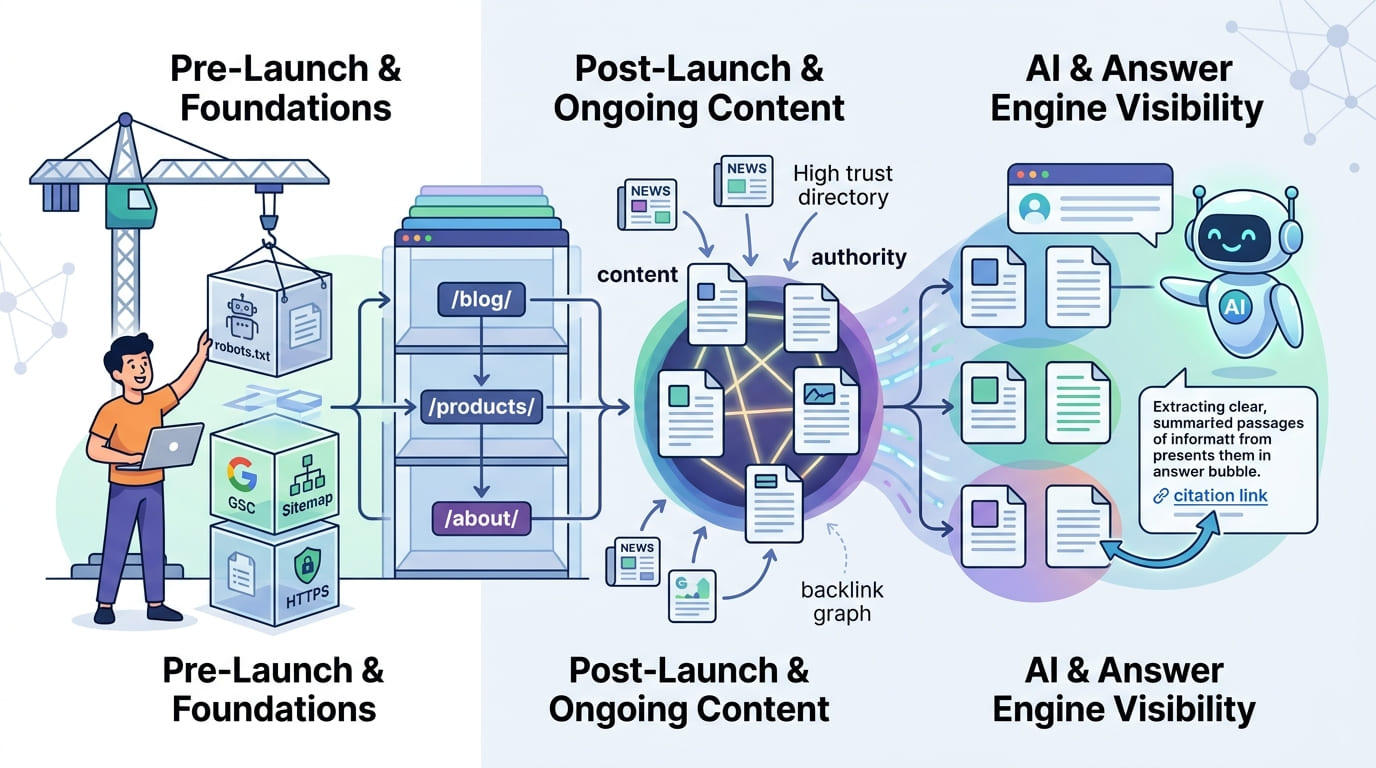
Your SEO Checklist: Before vs. After Launch
Lock in the structural decisions before you launch. Everything after launch is ongoing work, not a one-time task.
| SEO Area | Before You Launch | After You Launch |
|---|---|---|
| Technical | Choose HTTPS, mobile-friendly design, fast hosting; plan your robots.txt | Verify indexing in Search Console, submit sitemap, fix crawl issues |
| Architecture | Decide URL structure and page hierarchy (/blog/, /product/, etc.) | Add new pages into the existing structure; avoid ad-hoc URLs |
| Keywords | Map winnable keywords to core pages; create a roadmap | Expand into new keywords and questions as you publish |
| Content | Draft your core “money” pages and outline your first cluster | Publish supporting content steadily; refresh regularly |
| Authority | Claim your brand name, profiles, and key directories | Earn backlinks and mentions through PR, guest posts, communities |
| AI Visibility | Write clear, extractable, entity-rich pages from day one | Monitor AI mentions; build presence in sources AI trusts |
| Measurement | Set up Google Analytics 4 and Search Console | Track rankings and AI visibility; watch indexing before rankings |
The 90-Day Plan: Step-by-Step
Here’s roughly how your first 90 days should break down:
- Before launch – Lock down technical foundation, architecture, URLs; research keywords; draft core pages.
- Launch week – Set up Search Console and GA4, submit sitemap, run a site audit, confirm indexing.
- First 30 days – Publish your first content cluster; start a steady publishing cadence; fix crawl issues.
- Days 30 to 90 – Build authority with backlinks and brand mentions; work on AI visibility; watch for early ranking signals.
Step 1: Set Up the Technical Essentials
Before anything else, make sure search engines can find your site. No amount of content or keywords matters if your pages can’t be crawled.
Start with these four accounts and files:
- robots.txt – tells crawlers which pages to access and which to skip.
- Google Search Console (GSC) – gives you eyes on how Google crawls, indexes, and ranks your site.
- XML sitemap – submit it through GSC so Google has a complete list of your pages.
- Google Analytics 4 (GA4) – tracks what visitors do once they arrive.
Pro tip: On a new site, GSC won’t show much at first—that’s normal. Set it up early and let the data fill in.
Then run a technical crawl using a tool like Site Audit. Filter by “Indexability” to surface problems that stop pages from being indexed—fix those first, since they gate everything else.
Also confirm:
- Every page serves over HTTPS
- Your design is mobile-friendly (Google indexes the mobile version first)
- Your site loads fast (Largest Contentful Paint under 2.5 seconds)
Step 2: Plan Your Site Architecture and URLs
Decide how your pages are organized and how your URLs look before you publish. This is a cheap decision today and a painful one to reverse later.
Think about your site skeleton. Most new sites need: a homepage, an about page, core product/service pages, a contact page, and a blog—with room to expand each into subpages.
Decide your URL slugs now.
- Will blog posts live at
/blog/post-name/or/articles/post-name/? - Will products sit under
/category/product-name/or at the root?
Keep slugs short, descriptive, and keyword-focused. Avoid numbers and special characters. Once a URL is indexed and linked, changing it means setting up redirects—and every redirect is a small tax on your authority.
Step 3: Find Keywords and Prompts You Can Actually Win
Keyword research is how you learn what your audience types into search. For a new site, the goal isn’t the highest-volume keywords—it’s the ones you can realistically rank for and that lead to revenue.
Use a keyword tool to find ideas. Filter for a Personal Keyword Difficulty (PKD) under 20 and look for terms with 100+ monthly searches. Open the “Questions” filter to find long-tail queries—they’re usually easier to win because they’re more specific and less contested.
Pro tip: Prioritize by intent and revenue, not volume. Start with commercial, lower-funnel terms closest to a purchase, then expand into informational topics through your blog.
Don’t forget AI prompts. These are longer and more conversational than keywords (e.g., “what’s the best CRM for a two-person real estate team?” rather than “best CRM”). Use a Prompt Research tool to find real prompts people type into AI tools.
Map your keywords to specific pages—commercial keywords go on your core pages, informational ones go on blog posts.
Step 4: Create Content That People (and AI) Want to Cite
Content earns rankings and AI citations the same way: by being genuinely useful, organized into topics you cover in depth, and structured so a specific passage can be lifted out and cited.
Start with topic clusters, not random posts. A cluster is a pillar page on a broad topic plus supporting pages on its subtopics, all internally linked. This signals depth to search engines and gives AI a coherent body of work to draw from.
The single biggest differentiator for a new site? Original input. Your own data, tests, or first-hand experience. As one expert puts it: “Even small-scale experiments give search engines a compelling reason to rank you above established competitors.” Real-world proof gives both Google and AI a reason to recommend you over a bigger competitor who only summarizes.
Tighten your on-page basics:
- Title tags – clear, specific, under about 550 pixels, include your target keyword
- Meta descriptions – a sentence or two that earns the click
- Headings – use descriptive H2s and H3s that answer real questions
- Alt text – describe images plainly for accessibility and context
- Internal links – connect related pages so readers and crawlers can move through your cluster
Step 5: Build Authority with Backlinks and Brand Mentions
Backlinks (links from other sites) and brand mentions (references to your business, linked or not) tell search engines and AI that other people take you seriously.
But remember: you need to publish citable content before you worry about links. Once your core pages exist, here’s how to build links:
- Publish original research others want to reference
- Write guest posts for relevant blogs in your niche
- Claim your business in directories (Google Business Profile, etc.)
- Participate authentically in communities like Reddit
- Run digital PR campaigns to earn mentions on trusted publications
- Add relevant internal links between your own pages
Use a Backlink Gap tool to compare your profile against competitors and find sites that link to them but not to you.
Step 6: Show Up in ChatGPT, Perplexity, and AI Overviews
AI visibility is a different job from ranking, even though the foundations overlap. Ranking is about pages; AI citation is about passages and entities.
Four things that help a new site show up in AI:
- Entity clarity – state plainly what your brand is, what it does, and who it’s for
- Extractable structure – use short, self-contained sections with descriptive headings that answer one question each
- Consistent naming – use the same brand name, product names, and terminology everywhere
- Presence in trusted sources – get mentioned on review sites, directories, and community threads that AI models pull from
Measure your visibility. Use an AI Visibility Toolkit to see if and how you appear across ChatGPT, Gemini, Perplexity, and Google AI Overviews.
Use AI to Speed Up Your SEO (Safely)
AI isn’t a magic button, but it can make SEO faster—if you know what to delegate and what to keep.
| Task | Verdict | Why |
|---|---|---|
| Keyword and topic research | Delegate to AI | Suggestions you verify in a tool anyway |
| Clustering keywords into groups | Delegate to AI | You review before anything ships |
| First-pass outlines and briefs | Delegate to AI | A starting point, not the finished piece |
| Summarizing competitor pages | Delegate to AI | You still read the result |
| Choosing which topics to own | Human decision | A wrong call wastes months |
| Final content accuracy & experience | Human decision | AI can’t vouch for what’s true |
| Changes to live URLs/structure | Human decision | Expensive to reverse |
Keep final say over your strategy. Some tasks are safer to hand off than others.
Common Beginner Mistakes to Avoid
Most mistakes come from skipping the sequence. Watch out for these:
- Publishing before confirming indexing – if Google can’t find you, nothing else matters.
- Choosing URLs and structure after launch – the most expensive reversal on a new site.
- Chasing high-volume keywords you can’t win – volume feels like progress; winnable terms deliver it.
- Building links before you have citable content – authority-building only works when there’s something worth linking to.
- Ignoring search intent – a page that doesn’t match what the searcher wants won’t rank.
- Over-optimizing – forcing keywords everywhere hurts more than it helps.
- Skipping measurement – without Search Console, you’re guessing.
What to Expect: Timeline and Early Signals
Set realistic expectations by separating two clocks:
- Indexing is fast – days to a few weeks once you submit your sitemap.
- Ranking is slow – typically 4 to 12 months before you see meaningful movement.
Watch for early signals in this order (first 90 days):
- Pages move from “discovered” to “indexed” in Search Console
- First impressions on long-tail queries
- A handful of low-competition keywords enter the top 50
- Your first AI mentions
Track your rankings daily with a Position Tracking tool—and make sure it also tracks ChatGPT Search and Google AI Mode.
FAQ (Quick Answers)
Is SEO dead?
No—it’s expanding. The core job (being crawlable, relevant, and trustworthy) is exactly what earns visibility in both search results and AI answers.
How much does SEO cost for a new site?
DIY costs little more than a tool subscription plus your time. Hiring an agency buys speed and expertise. Start DIY and add help as you grow.
Can I teach myself SEO?
Yes. The basics (crawling, indexing, keywords, content, links) are very approachable. A motivated beginner can run competent SEO within a few weeks.
Do I need an agency?
Most small business owners can DIY at first. Consider an agency when SEO becomes a meaningful revenue channel or you’re in a very competitive niche.
Why does SEO matter from day one?
Because the cheapest, highest-impact decisions all happen before you have traffic. Architecture, URLs, and a clear content plan cost nothing to get right early and a fortune to fix later.
The inclusion of AI visibility (GEO/AEO) as a distinct step is brilliant. Most new-site SEO guides still treat AI answers as an afterthought, but with ChatGPT hitting 900 million users, being cited in AI responses is now a first-class objective—not a bonus.
The “what to delegate vs. what to keep” table is worth printing out and sticking on your wall. It cuts through the hype around AI replacing SEOs and gives a practical, safe framework for using AI as an assistant rather than a crutch.